
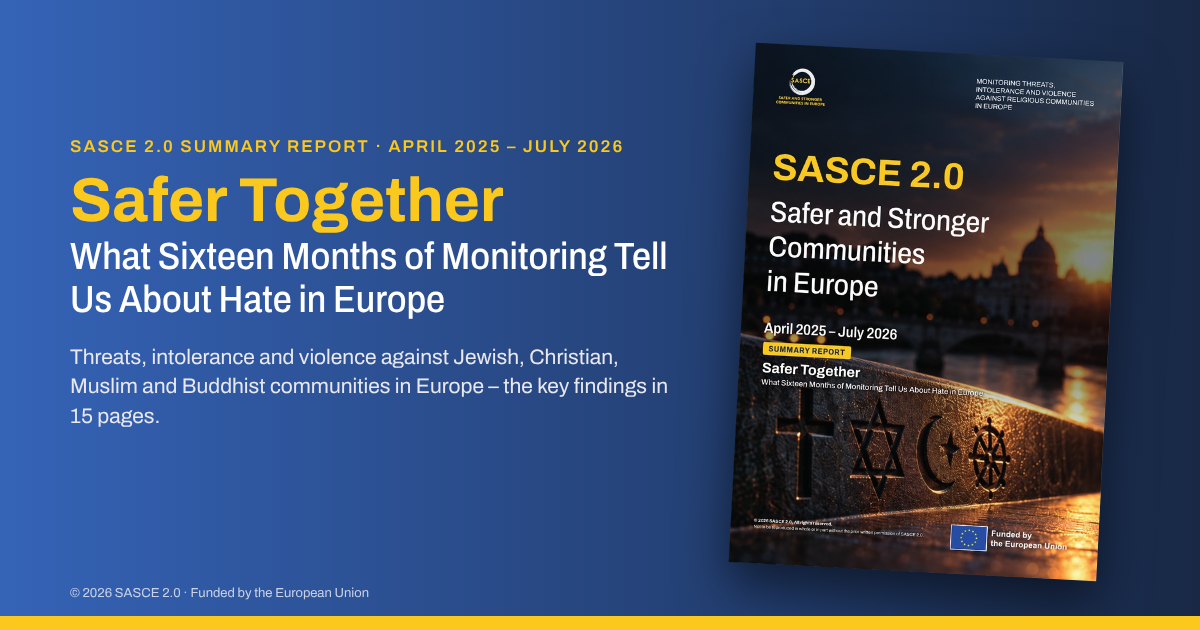
What Sixteen Months of Monitoring Tell Us About Hate in Europe
Hostility towards faith communities in Europe is getting more dangerous, and it now touches every faith.
Between April 2025 and July 2026, the SASCE 2.0 partners tracked threats, intolerance and violence against Jewish, Christian, Muslim and Buddhist communities across Europe. The picture at the end of the period is worse than at the start. Incidents and security operations recorded by SACC by EJC grew from around 20 a month to around 80. Attacks shifted from graffiti and vandalism towards fire, explosives and knives. People were killed in a synagogue attack in Manchester and a van and machete attack in Berlin, and many more plots were stopped only at the last stage.
The State of Hate in Europe
- J
 ewish communities face the most sustained threat. Antisemitism made up more than half of the 864 SACC entries. In spring 2026, synagogues, Jewish schools and community ambulances in Liège, Rotterdam, Amsterdam, London and Skopje were hit by firebombs and explosions, some linked to Iran-backed networks. Two Jewish men were stabbed in Golders Green in April 2026, and the UK raised its terrorism threat level to severe.
- Christian places of worship are attacked every week. OIDAC Europe recorded 334 anti-Christian hate crimes in nine months, between 30 and 41 every month. Most were vandalism and arson against churches, mainly in Germany, France and Italy.
- Muslim communities face attacks on mosques and on the street. Faith Matters documented arson, a pipe bomb and pigs’ heads left at mosques, alongside anti-immigrant riots in Spain and Northern Ireland. In France, recorded anti-Muslim incidents rose by 88% in 2025, and an EU survey found almost half of Muslims had experienced racial discrimination.
- Buddhist communities report harassment and theft in Europe and serious pressure in parts of Asia where Buddhists are a minority, including Bangladesh, India and Tibet.
- Extremism is getting younger. Teenagers, some as young as 14, were arrested over jihadist and far-right plots in at least eight countries, often radicalised and recruited through TikTok, Telegram and Snapchat.
- Hostile states are exploiting the tensions. Iran- and Russia-linked networks paid criminals and young recruits to carry out attacks and sabotage, prompting the EU and the UK to move against Iran’s Revolutionary Guard.
Why Together
The threats differ from one community to another, but the patterns are shared. Places of worship are targeted across all four faiths. The same online channels radicalise young people towards jihadist and far-right violence alike. An attack on one community often raises fear in all of them.
That is why SASCE 2.0 exists. For the first time, representatives of Europe’s Christian, Buddhist, Muslim and Jewish communities are working together on a common project to improve security in and around places of worship and to build trust between the four faiths. Monitoring hate side by side is the first step: it shows what each community faces, and how much they have in common. Communities that understand each other’s risks, and stand up for one another, are safer together.
What the Report Offers
This 15-page summary brings together, in one place, what four organisations monitoring hostility against Europe’s faith communities found over sixteen months. It includes clear charts, findings for each type of threat and each faith community, and a month-by-month timeline of key incidents and responses. It is written for policymakers, security professionals, faith leaders and anyone concerned with keeping communities safe.
The figures come from monitoring of media reports, official statements and the work of monitoring bodies. They are not official crime statistics, and the true level of hostility is likely to be higher.
Compiled from information contributed by SACC by EJC (Security and Crisis Centre of the European Jewish Congress), OIDAC Europe (Observatory on Intolerance and Discrimination against Christians in Europe), Faith Matters and the European Buddhist Union.